A child asks it on the playground. A student asks it before an exam. A manager asks it before a hard decision. A parent asks it at the dinner table. What is right? And why should I do only the right thing, when the wrong thing seems easier?
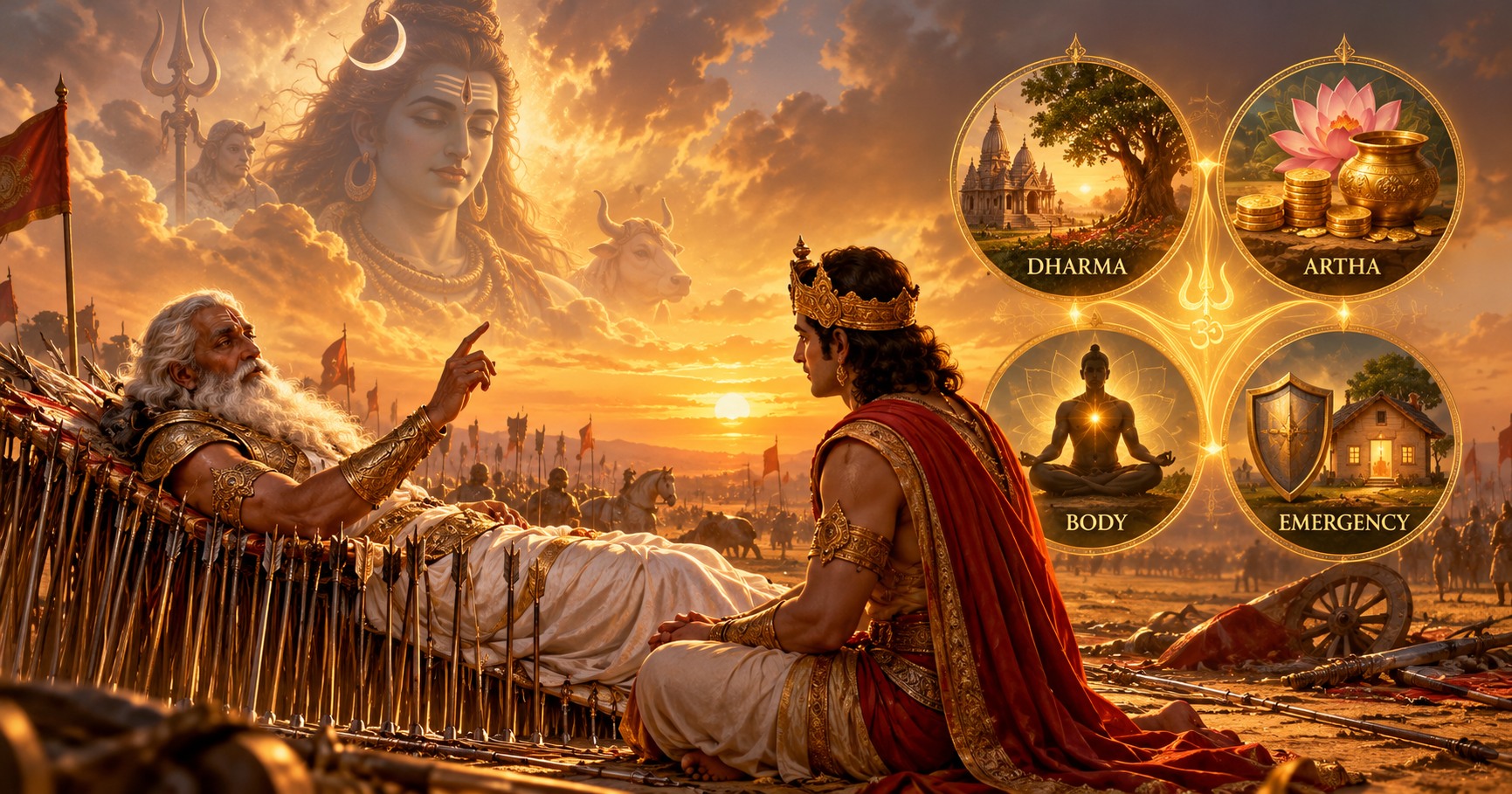
This question has no age limit. And it is exactly the question that troubled Yudhishthira, the most righteous of the Pandavas, as he lay before his grandfather Bhishma on the bed of arrows after the Kurukshetra war. In the Shanti Parva of the Mahabharata, the new king asks for guidance. Bhishma's answer is surprisingly practical, and still speaks to us today.
The question of a reluctant king
Yudhishthira was known as Dharmaraja, the king of righteousness. Yet even he admits that dharma is hard to follow.
“O Grandfather! The knowers of dharma say, 'Dharma is the greatest of all for kings,' don't they? But I find it very difficult to follow that dharma. Please tell me about this.”
He goes further. Among the three aims of life, dharma (righteousness), artha (wealth) and kama (desire), he says statecraft is supreme and essential for human life. If he does not rule the way his ancestors did, sin will increase and dharma will weaken. Controlling wrongdoing through good governance is itself righteous, and only then will the people see their king as righteous.
So he asks Bhishma to explain this statecraft in a way he can fully understand. It is an honest question: I want to do right, but how?
Lesson 1: Begin with the divine, and accept the outcome
Bhishma starts not with rules but with attitude. A king who wants his own well-being must first worship the deities, because divine power is needed for any undertaking. When human effort is joined with divine grace, the gods help too.
And when an effort fails? The king should not grieve. He should accept it as divine will and move on.
Bhishma then lists what makes a ruler excellent: good qualities, adherence to dharma, control over the senses, freedom from evil thoughts, and ambitious goals. Under such a king, he says, the people live happily and contentedly.
For us today: do your best, stay humble, and do not let failure break you. Doing right is about effort and character, not guaranteed results.
Lesson 2: Being right is not the same as being only soft
Here Bhishma says something many of us do not expect. Being good does not mean being a pushover.
- If you only ever think of being nice and never wanting to hurt anyone, no one will respect you.
- If you are always laughing, lost in pleasures, and care more about adornments, food and comfort than dharma, even wicked people will take advantage of you.
- If you are cruel, no one will like you.
So what is the answer? Act according to the situation. Join hands where friendship is needed. Fight where war is necessary. That, Bhishma says, is the dharma of a king.
For us today: right action is not a fixed mood. Kindness and firmness are both tools. A good parent, teacher or leader knows when to comfort and when to correct.
Lesson 3: Iron and rock, fire and water
Bhishma then speaks about the relationship between Brahmins, the keepers of Vedic knowledge, and kings. He uses two vivid images:
“My son! Iron is born from rock. If that very iron is used to strike a rock, the rock breaks. Fire is born from water. But if one tries to burn water with fire, it extinguishes.”
In the same way, he says, a king is created by a Brahmin. A king who insults the source of his own knowledge and legitimacy invites his own destruction. Brahmins embody the Vedas, so the king must respect and protect them.
But in the very next breath, Bhishma adds a crucial balance: if a Brahmin commits a mistake, there is no need to forgive him. The king must punish a Brahmin who does wrong too.
For us today: honour the people and traditions that shaped you. But respect is not a licence. No one, however revered, stands above what is right.
Lesson 4: Justice with proportion, compassion for all
Bhishma quotes the Sukra Niti to show that justice must fit the deed. In war, a king may rightly slay even a Brahmin who comes at him with weapons. But for grave crimes, such as lusting after a guru's wife, killing infants, killing a fellow Brahmin, or committing treason, the offender is to be banished from the kingdom, not killed.
Then comes the line that ties it all together:
“And not just Brahmins, a king must show compassion to people of all four varnas. He must rule all of them like his own children.”
For us today: fairness means the same standard for everyone, a response that matches the wrong, and care even while correcting. Discipline without compassion becomes cruelty. Compassion without discipline becomes weakness.
So, why should we do only right things?
Bhishma never gives a one-line definition of “right”. Instead, his answer to Yudhishthira shows why it matters:
- Because others depend on you. A righteous king means a happy, contented people. Your choices shape your family, team and community.
- Because wrong grows when ignored. Yudhishthira himself says that without good rule, sin increases and dharma diminishes.
- Because trust is earned through right action. People acknowledge a king as righteous only when he acts righteously.
- Because right action is wise, not weak. Doing right means knowing when to be gentle and when to be firm.
- Because it gives you peace. If you act rightly and still fail, you need not grieve. You did your part.
Whether you are eight or eighty, the test is the same: Does this choice protect others? Is it fair to everyone? Would I accept the same standard for myself?
A closing thought
Yudhishthira found dharma difficult, and he was not ashamed to say so. That may be the first lesson of all: doing right begins with asking honestly how to do it. Bhishma's answer, given from a bed of arrows, still holds. Be humble, be balanced, be fair, and treat everyone in your care like your own children.
Explore more timeless stories from the Mahabharata and Ramayana on Lipi Epics.