Mahabharata | Lipi Epics
Lord Shiva shares a money formula in the Mahabharata that most people never follow, and that is why so many of us always feel broke, no matter how much we earn.
Think about it. Your salary arrives on the first of the month. By the twentieth, it is gone. A raise comes, and within a few months that feels short too. The problem is rarely the amount. It is that the money has no plan.
This isn't modern finance. It is ancient life science.
Bhishma's lesson to Dharmaraj
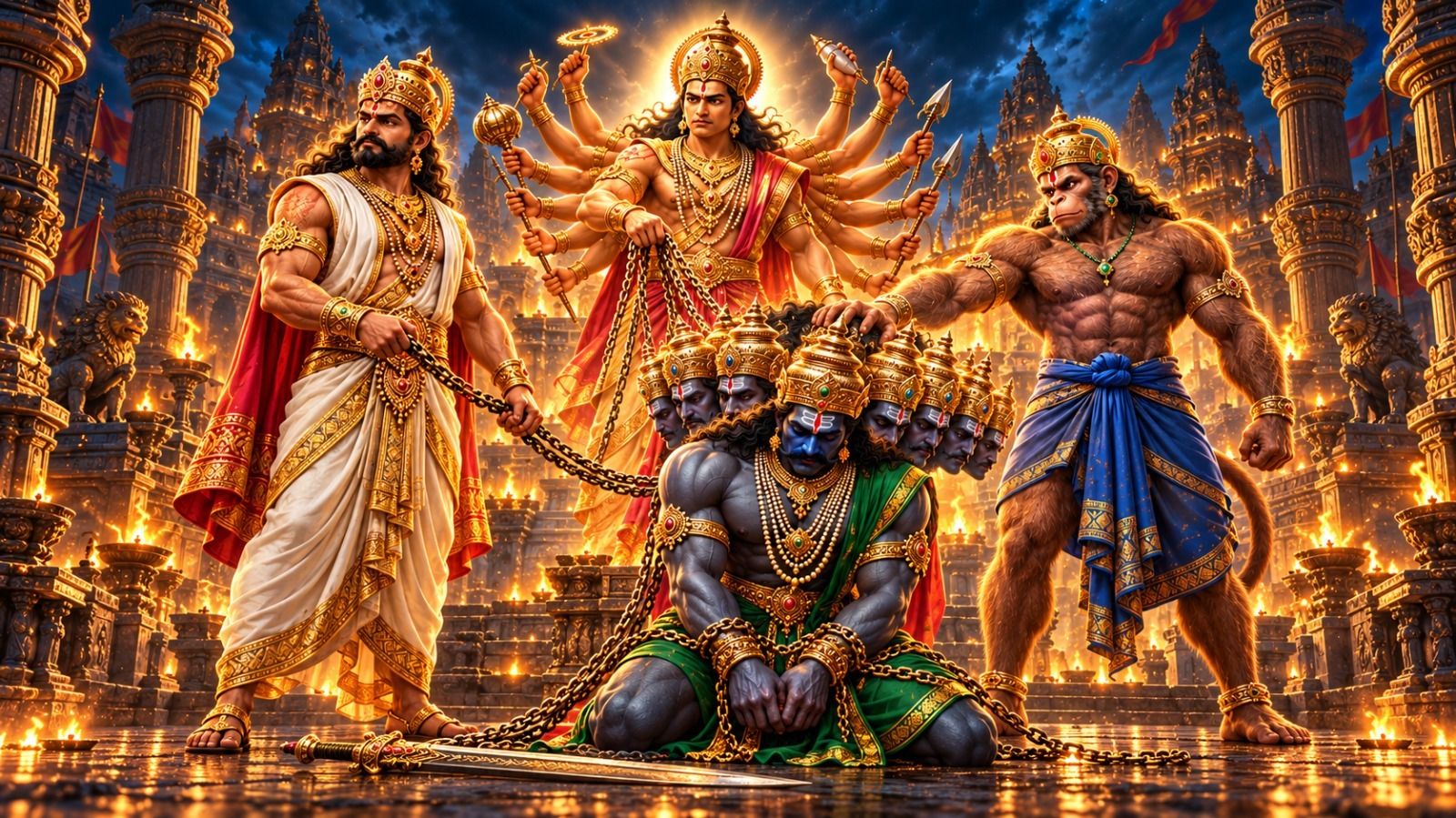
The war is over. Kurukshetra is silent. Yudhishthira, the Dharmaraj, has won the throne, but his heart is heavy. He has a kingdom to run and no idea how to carry it.
So he goes to the one man who knows: Bhishma, the grandsire, lying on his bed of arrows, waiting for the auspicious hour to leave his body.
Day after day, Bhishma teaches him. Duty, justice, kingship, and money. He tells Yudhishthira that wealth is not the enemy of dharma. A household, like a kingdom, cannot stand without it. But wealth without wisdom destroys the very people who hold it. The Dharmaraj had seen that with his own eyes, when a single game of dice took everything the Pandavas owned.
Then Bhishma goes further. He recounts what Lord Shiva himself taught about managing what a person earns. It is a formula meant not only for kings, but for every person who works for a living.
That formula is the Wealth Code.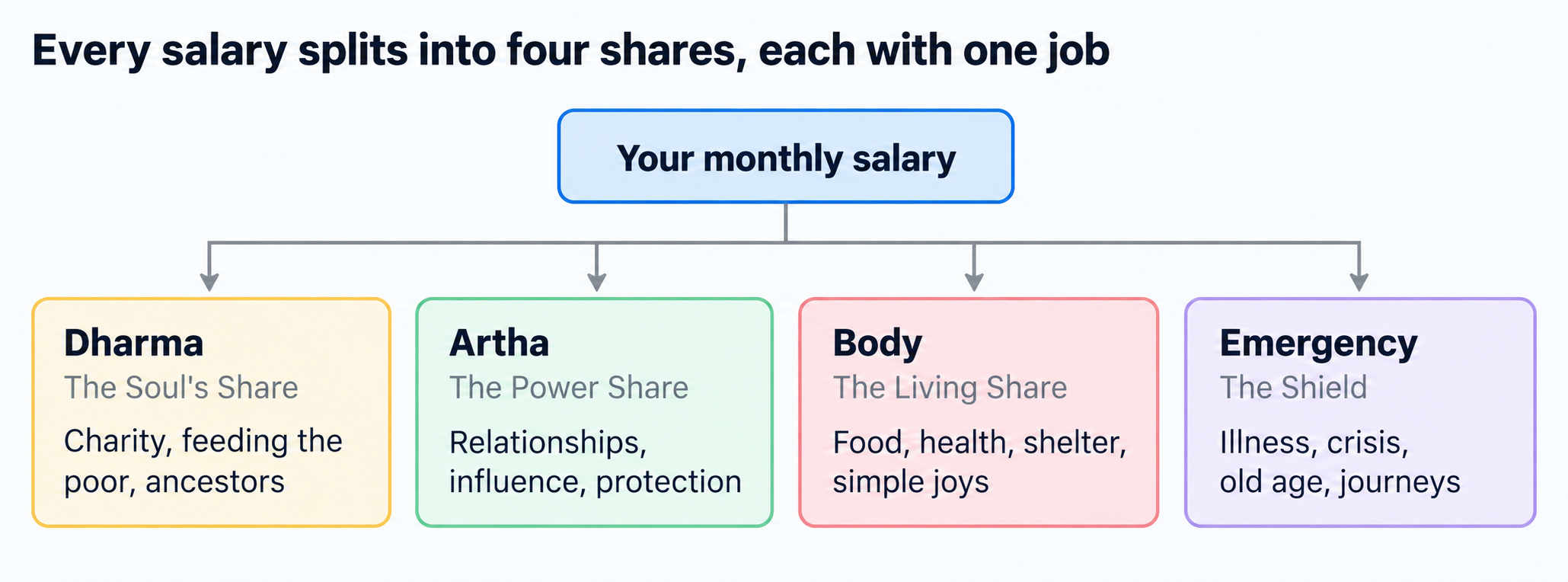 Shiva's Wealth Code: four shares of one salary
Each share takes its part on salary day, before any spending begins.
Why a 5,000-year-old epic talks about money
The Mahabharata is not only a story of war. It is a manual for living, and money sits right at its centre. Kingdoms are won and lost over wealth. The Pandavas lose everything in a single dice game because wealth was handled without wisdom.
The epic never tells you to reject money. It treats artha, prosperity, as one of the four legitimate goals of life, alongside dharma, kama and moksha. The question it asks is not "how much do you earn?" but "what is your money for?"
Business schools teach you to grow income, cut costs and maximise returns. They rarely teach purpose. Shiva's answer is simple: divide every income into four parts, and give each part a job.
1. Dharma: the Soul's Share
What it covers: charity, feeding the poor, helping those who suffer, honouring your ancestors and sacred acts.
Why it matters: this share keeps your karma clean and your heart peaceful. It is the share most budgets leave out, and it is the one Shiva names first. A person who only takes is never satisfied, however much they gather. Giving breaks the feeling of scarcity, because it proves to you that you have enough to share.
How to start:
- Set aside this share the day your salary arrives, before any spending
- Choose one cause you care about and give to it every month
- Feed someone: a meal for a worker, a donation to an annadanam, food for animals
- Mark your ancestors' days with an act of giving in their name
Common mistake: waiting to give "once I'm rich." The habit builds the wealth, not the other way round.
2. Artha: the Power Share
What it covers: building relationships, gaining influence, protecting yourself and preparing for danger.
Why it matters: this share builds your strength in the world. In the Mahabharata, the Pandavas survive exile because of the alliances they built: Krishna, Drupada, Virata. Their relationships were their real treasury.
How to start:
- Invest in skills and courses that raise your earning power
- Spend on the people and networks that open doors: a meal with a mentor, a professional event
- Buy protection: health insurance, term insurance, legal safeguards
- Put money into assets that grow, so your income is not your only source of strength
Common mistake: treating this share as "extra." Without it, your income stays where it is.
3. Body: the Living Share
What it covers: food, health, comfort, shelter and simple joys.
Why it matters: this is not luxury. This is dignity. Shiva doesn't ask you to deny yourself. He asks you to care for the body that carries your purpose. A person who saves everything and lives miserably has missed the point as surely as one who spends everything.
How to start:
- Cover rent, groceries, bills and transport from this share
- Spend on health: good food, exercise, regular check-ups
- Allow yourself simple joys: a family outing, a festival, a good book
- Keep this share honest; when it runs out, wait for next month
Common mistake: letting this share eat into the other three. That is how a salary disappears by the twentieth.
4. Emergency: the Shield
What it covers: savings for illness, crisis, old age, survival and spiritual journeys.
Why it matters: this is the wall between you and fear. When it exists, a hospital bill or a lost job is a setback, not a disaster. The Pandavas faced thirteen years of exile. Life brings its own exiles to everyone; the shield decides how you live through them.
How to start:
- Build a fund that covers at least six months of living expenses
- Keep it separate and easy to reach, not in your spending account
- Once it is full, direct this share to retirement savings
- Set aside something for a pilgrimage or journey that feeds the spirit
Common mistake: dipping into the shield for wants. It is for crises only.
What this looks like on a real salary
As an example, here is a monthly take-home salary of ₹60,000 split into four equal parts. Adjust the proportions to your life; the habit of dividing matters more than the exact numbers.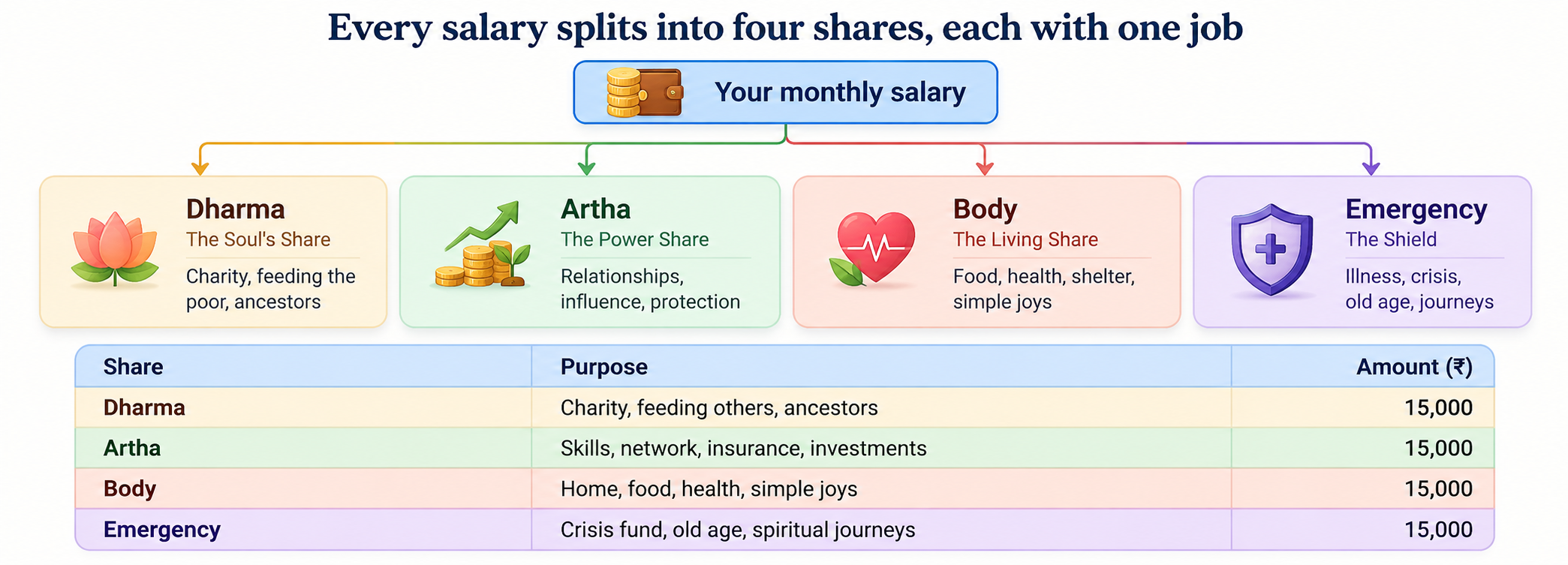 If your living costs need more than a quarter today, start smaller on the other shares, but never at zero. Even ₹500 to dharma and ₹2,000 to the shield builds the habit.
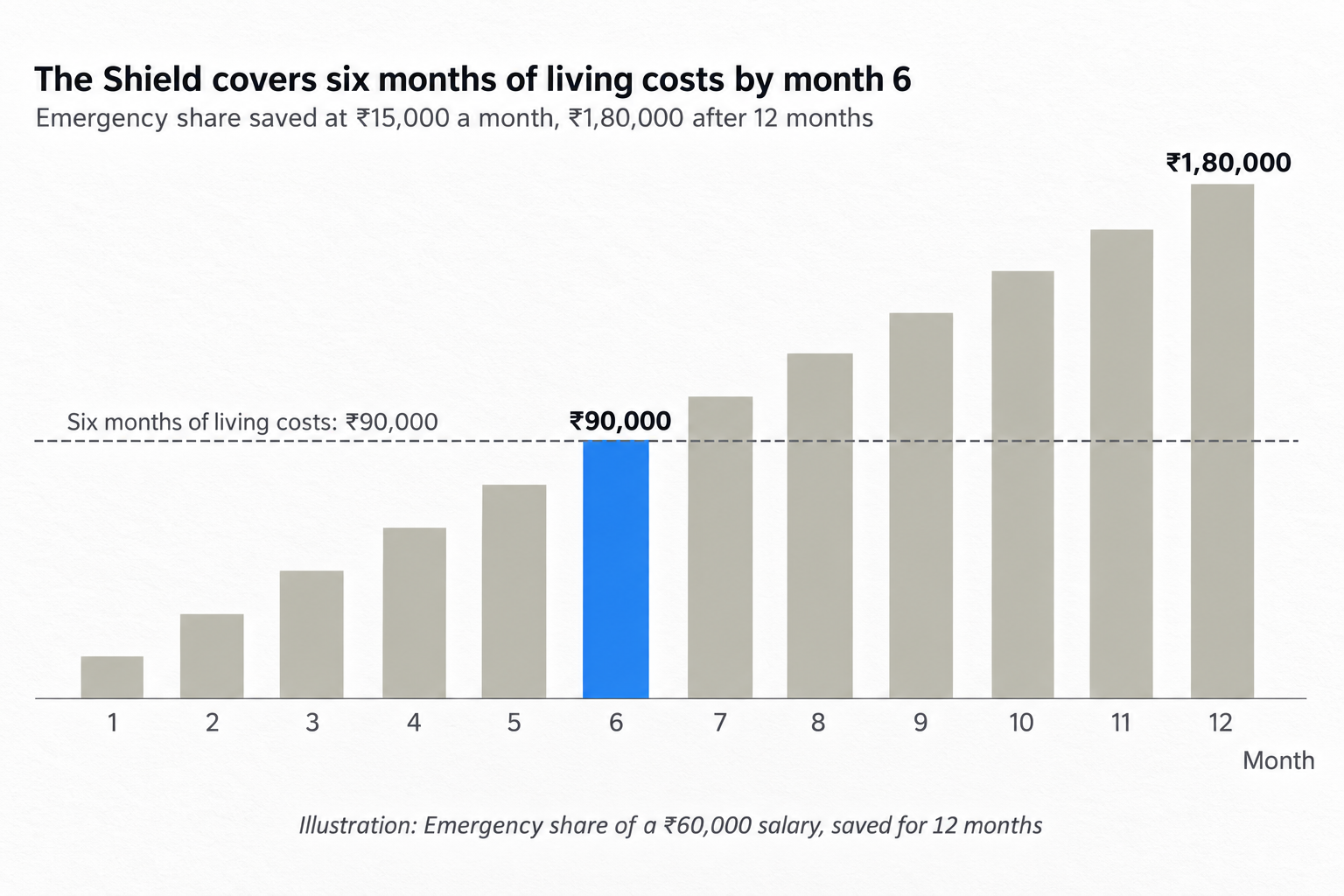 Once the Shield covers six months of living costs, every further month builds savings for old age and spiritual journeys.
Your first 30 days with the Wealth Code
- Day 1: Write down your monthly take-home salary
- Day 2: Open separate accounts or envelopes for the four shares
- Day 3: On salary day, move money into all four before you spend anything
- Week 2: Make your first act of giving from the dharma share
- Week 3: Use the artha share for one skill, one connection or one policy
Week 4: Review: which share did you raid? Fix that next month
Why this beats a spreadsheet
Modern budgeting rules split money into needs, wants and savings. Shiva's code adds what they miss: a share for others and a share for your standing in the world. It treats money as a tool for a whole life, not only a balance to grow.
The result is not just more money. It is a different feeling about the same money: peace from giving, strength from building, dignity from living well, and freedom from fear.
The final word
Shiva says: money is life. Happiness grows with wise wealth.
Start this month. Divide before you spend, and watch your salary start working for your whole life.
Explore more stories from the Mahabharata on Lipi Epics.