The Mahabharata is one of the longest epic poems ever composed, traditionally said to contain around one lakh (100,000) verses. It includes the Bhagavad Gita, the Kurukshetra war, and some of the deepest lessons on duty, loyalty, leadership, and dharma.
But have you ever wondered who wrote the Mahabharata and how such a vast story was put into words?
According to Indian tradition, Maharishi Ved Vyasa composed the Mahabharata, while Lord Ganesha wrote it down as Vyasa dictated.
Here is the fascinating story of how Ganesha wrote the Mahabharata.
Vyasa's Challenge: A Story Too Vast to Record
Maharishi Ved Vyasa, also known as Krishna Dvaipayana, was not only the composer of the Mahabharata but also a part of its story. He was closely connected to the families of both the Kauravas and the Pandavas.
Vyasa had conceived an enormous epic filled with battles, conversations, philosophy, relationships, and timeless lessons.
But there was a challenge.
The Mahabharata was so vast and detailed that Vyasa needed someone capable of writing as quickly as he could dictate. No ordinary scribe could keep up with the flow of such a great composition.
Why Brahma Chose Ganesha
According to tradition, Vyasa sought guidance from Lord Brahma, the creator.
When Vyasa asked who could possibly write down such a vast epic, Brahma advised him to invite Lord Ganesha to become his scribe.
Why Ganesha?
Tradition gives several meaningful reasons:
1. Ganesha is the god of wisdom and intellect
Writing the Mahabharata required more than simply copying words. The scribe had to understand philosophy, dharma, strategy, and human emotions.
2. He is the remover of obstacles, Vighnaharta
A task as enormous as recording the Mahabharata would naturally face challenges. Ganesha represented the wisdom needed to overcome them.
3. He is associated with knowledge and learning
Ganesha has long been honoured as a symbol of wisdom, education, and new beginnings.
4. He is worshipped before important beginnings
In Indian tradition, important tasks often begin by remembering Lord Ganesha.
For a work as significant as the Mahabharata, Ganesha was the ideal scribe.
The Famous Condition: “Do Not Stop”
Vyasa approached Lord Ganesha and asked him to write the Mahabharata.
Ganesha agreed, but with one condition:
Vyasa must dictate continuously without stopping.
If Vyasa paused, Ganesha would stop writing.
Vyasa accepted the condition but added one of his own:
Ganesha must fully understand every verse before writing it down.
Ganesha agreed.
And so the writing of the Mahabharata began.
Vyasa's Secret: The Difficult Verses
Vyasa now faced an unusual challenge.
He had to continue dictating without pausing, but even a great sage needed time to think and compose the next verses.
Vyasa found a clever solution.
Whenever he needed time to think, he would dictate a verse that was extremely complex and layered in meaning.
Because Ganesha had agreed to understand every verse before writing it, he would pause to think about its meaning.
During those moments, Vyasa would prepare the verses that came next.
These difficult verses are traditionally associated with Vyasa-kuta, often described as “Vyasa's knots.”
The story highlights an important idea: knowledge should not simply be written or repeated—it should first be understood.
Why Ganesha Has One Tusk: The Ekadanta Story
One of the most popular stories connected with the Mahabharata explains why Lord Ganesha is called Ekadanta, meaning “the one with a single tusk.”
According to this popular tradition, Ganesha's writing instrument broke while he was recording Vyasa's verses.
But he could not stop writing.
So, without hesitation, Ganesha broke off one of his tusks and used it as a writing instrument to continue the Mahabharata.
The story carries a powerful lesson:
When you truly commit to something meaningful, you find a way to complete it despite the obstacles.
There are other traditional stories explaining how Ganesha lost his tusk, but this is the version most closely associated with the Mahabharata.
Did It Really Happen This Way?
The story of Ganesha writing the Mahabharata is one of the most loved traditions connected with the epic.
However, scholars have noted that the episode appears in some versions and traditions of the Mahabharata but not in others. The Critical Edition prepared by the Bhandarkar Oriental Research Institute does not include the Ganesha-scribe episode in its reconstructed core text.
Even so, the story has lived for centuries through Indian art, temples, literature, and family storytelling.
It continues to represent some of the most important values associated with the Mahabharata: wisdom, patience, understanding, discipline, and commitment.
Lessons From the Story for Today
Choose the right partner for a big goal
Vyasa had the vision, while Ganesha had the discipline and ability to record it. Great work often requires both.
Understand before you act
Ganesha would not write a verse without understanding its meaning—a valuable lesson for students and professionals alike.
Keep your word
In the popular Ekadanta story, Ganesha uses his own tusk rather than allowing the writing to stop.
Think smart under pressure
Vyasa's difficult verses show how intelligence and creativity can help us work within challenging conditions.
Experience the Mahabharata on Lipi Epics
If this story made you curious, there is much more to discover inside the Mahabharata.
Explore stories such as Karna's loyalty, Bhishma's vow, Draupadi's courage, Arjuna's journey, and Krishna's wisdom in the Bhagavad Gita.
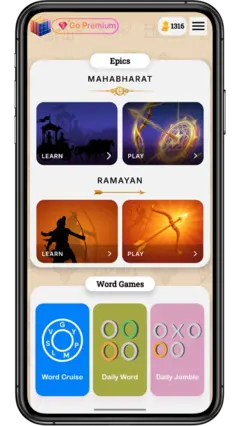
Lipi Epics is a Mahabharata and Ramayana learning app designed to make India's great epics simple and engaging for learners of different ages.
With Lipi Epics, you can:
- Read or listen to stories in simple language
- Play games and take quizzes
- Enjoy 4 free stories every day
- Earn certificates as you complete your learning journey
Whether you want to learn the Mahabharata online, revisit the stories you heard while growing up, or explore them with your family, Lipi Epics brings the Mahabharata and Ramayana to your phone in an interactive way.
👉 Download Lipi Epics and start your Mahabharata journey today.
Frequently Asked Questions
Who wrote the Mahabharata?
The Mahabharata was composed by Maharishi Ved Vyasa. According to tradition, Lord Ganesha served as his scribe and wrote down the verses as Vyasa dictated them.
Why did Brahma choose Ganesha to write the Mahabharata?
According to tradition, Brahma advised Vyasa to approach Ganesha. Ganesha is associated with wisdom, intellect, learning, and the removal of obstacles, making him an ideal scribe for such a vast work.
What was Ganesha's condition for writing the Mahabharata?
Ganesha asked Vyasa to dictate continuously without pausing. Vyasa agreed but added his own condition: Ganesha must understand every verse before writing it.
Why does Ganesha have one tusk?
In a popular story connected with the Mahabharata, Ganesha's writing instrument broke while he was recording Vyasa's verses. He broke off one of his tusks and used it to continue writing without stopping.
How many verses are in the Mahabharata?
The Mahabharata is traditionally said to contain around 100,000 verses, making it one of the longest epic poems in world literature.
Where can I learn the Mahabharata online?
You can read, listen to stories, play games, and take quizzes based on the Mahabharata through Lipi Epics.